Apple cider making

Easter – cider and jelly and the ‘blood moon’

We spent yesterday and Friday making cider and then several years worth of apple jelly with the ‘pomace’. Chili jelly, mint jelly, sage jelly, and normal apple. As I used up about 8 kilos of sugar I listened to a show on National Radio how bad sugar is, and another about making cider (did you know commercial cider has only 30% apples?)

It was rainy for part of the day yesterday, so a good day for making jelly. The day before was fine, so a good day for making cider.

Cider making is so messy and there are lots of buckets and the chopper and the press to be hosed off afterwards so it’s nice to do that outdoors in the sun over some dry part of the garden.

Easter is a great time to do this as it really took the best part of 2 days. In a pinch you could freeze the pomace and do it later though.

Half of the apples we used were frozen apples from last year. These were very ripe when they were frozen. We kept ‘sweating’ them last year while we waited to have time to make the cider. Finally they started going off so we just put them in plastic bags in the freezer. These provided the ‘Sweet’ and most of the raw ones from this year were Grannies and not terribly ripe so that provided the sour. We even put in a few of our crab apples.

The frozen apples made lots of sweet juice – they released the juice much more easily for the cider. I would do this again, even if it’s just putting early sweet apples in the freezer for a month or so.

It’s the sort of thing where most of the time is in the clean up and set up, so you could easily make double or triple the amount. Next time it would be better to cut the apples up before freezing, as they take a lot of freezer space whole. They also tend to clog the chopper so it would be better to mix the raw and frozen from the start.

Using frozen apples meant there was less juice left in the pulp for jelly, which meant a lot of water needed to be added. It still set properly, so the pectin was still there, and it absorbed the mint and Chili flavour well and tasted good. I think it would be fine for pectin too. For the plain apple jelly I used the raw pomace. I couldn’t use all of it so the worms had a good feed as well.

We tried 2 mint jelly recipes – one where you cook the apple with mint and vinegar, the other you just make normal jelly and then drag a bunch of mint in the jelly and add a few drops of green colouring before bottling. Both have chopped mint in the jar. Dragging the mint in the jelly gives a surprising strong fresh mint flavour so we did that for both. We will do a side by side test tonight with lamb roast.

The sage jelly and chili jelly both have a bit of vinegar in them as well. We tried the chile jelly on crackers last night. Quite hot and nice with cream cheese. I used about 12 diced red little hats and 1 green jalapeño all with seeds – initially for one batch, but I added more juice and sugar as it seemed very hot. I suspect it will get milder as time goes past.

I found that a kilo of sugar is about 4 cups, so that’s a lot of jelly, about 30 medium jars. The apple jelly smells like fresh apple juice and is nice on toast.

Apple Jelly

The 14 litres of cider is bubbling away nicely. This will go back to the city to bubble in the dark cupboard under the stairs for the next few months. We also had an extra 3 litres of juice for drinking as we didn’t have another Demi john. This was from about 4 big baskets or bins full of apples – 2 from last year and 2 from this year.

We celebrated by drinking some of the 2 year old cider which was delicious. It’s lighter than wine in alcohol and has a dry sparkling taste. Nothing like the sweet cider you buy. I could drink a lot more of it if we had more apples.

We watched the eclipse, it was clear for long enough to see it disappear slowly over about half an hour.
Bread and Butter Pickles

Bread ‘n’ Butter Pickles

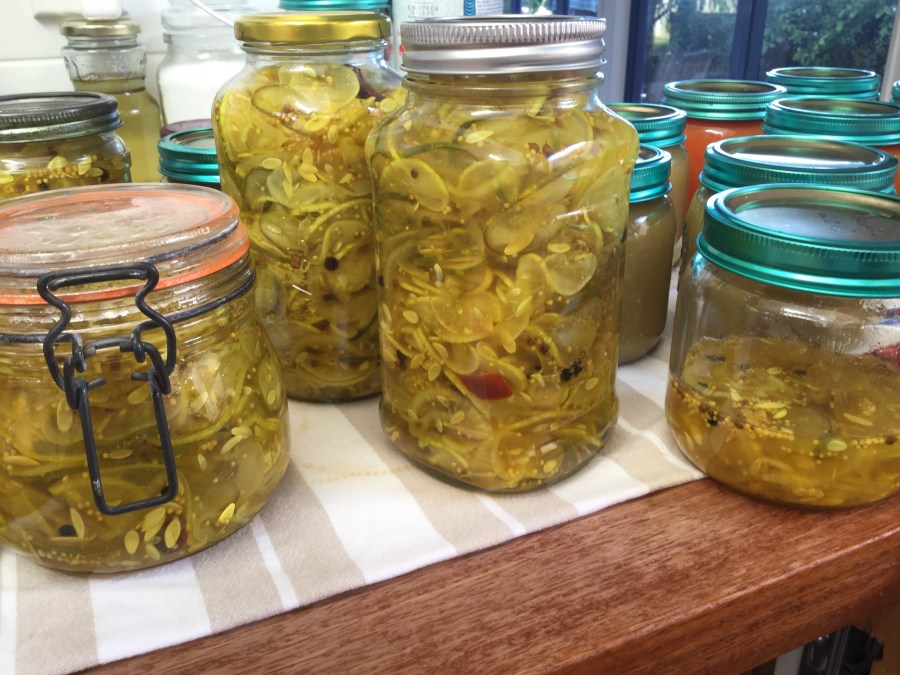
I made bread and butter pickles with my gherkins which grew too big and Apple Cukes mixed. They are yummy with strong cheddar cheese and sourdough bread. There are still a few more this week so I might make a few more.

Mandolin for vegetable slicing
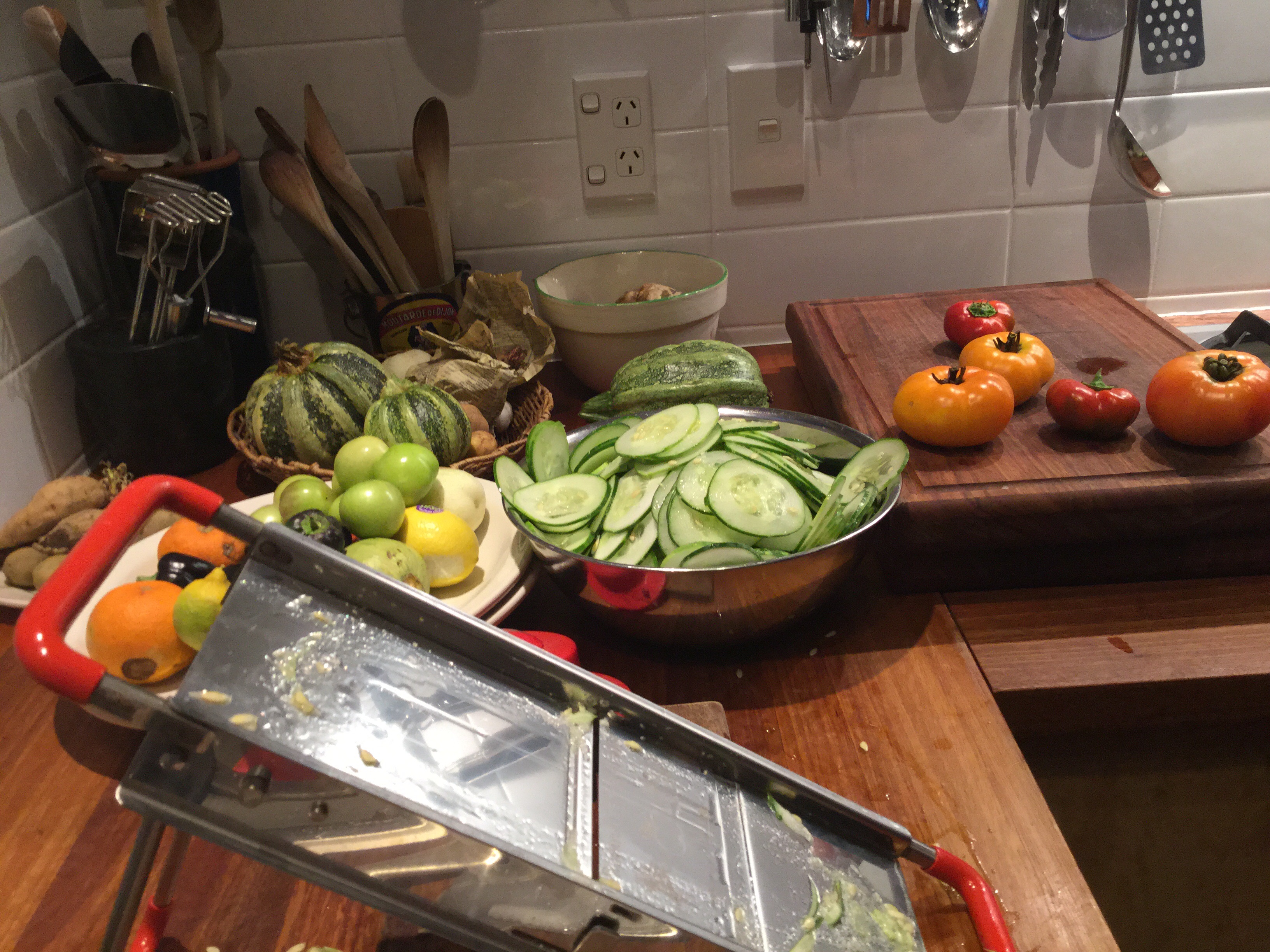
Having avoided the mandolin for years after seeing Rick Stein cut himself with one on TV, we used it and it saved so much time and did such a good job – and no injuries!

Making pickles with a mandolin

 Cutting Cucumbers on a mandolin

Last slices on the Mandolin

Putting the holder on for the last bit

Instant! And all even and thin. 🙂

Planting – foxgloves, jalapeños, sweet corn, beetroot, and Daikon

I’ve come inside now and left all my wet rain gear in the greenhouse to dry. It’s quite cold, but it seems wrong to have the heater on. I have given up and turned it on anyway.

Today I have planted Foxgove seeds in flats – Strawberry Merton and Pams, which is white with boysenberry blobs. I’ve also planted a flat of white cosmos, transplanted some scented geranium cuttings, and put the finished tulip bulbs to dry in the greenhouse.

I took some cornflower seeds off some tall blue ones at Lynn’s last week and planted them last weekend and they popped up right away. I put them in separate pots today although they only had their seed leaves. Same with the Jalapeños. I finally got the seed in last week from a dry one left from last year. On the hot pad they all came up right away so I separated them all into a flat so they will survive in the greenhouse over the week without water.

I’ve done a bit of hoeing between storms to get a place ready to plant beetroot- I have Golden Detroit and Detroit Dark Red and also Daikon to plant. The parsnips and carrots are up and weeded. Radishes seem to have been eaten.

Weeds and grass have grown so quickly over the last few weeks the grass is knee high in some places. Luckily the trees are shooting away too, the Feijoas and Pohutakawa have so much new growth they seem a third bigger.

I read about people who don’t mow any grass and I like the idea, but then every time you walk anywhere you would get soaked by wet grass, and it would squash all my little tiny plants – all the freesias, and saxifrages, and probably all the salvias and sun loving plants too. It almost seems like mowing is the only way to stop from being overgrown completely.

The bread seed poppies, which are a type of opium poppy are out with their fabulous graduated red and pink flowers. The plants themselves seem a bit spindley this year- I think they might need more lime or fert than the soil in the areas they popped up can provide.

The roses are looking good as well. The rugosas don’t seem to have the amount of scent I had expected but are finally doing better now that they are in better soil with fewer weeds. Before they were basically growing in clay and sand surrounded by long grass and they didn’t like it.

One lot of baby starlings seem to have grown up. I think it was them scrambling and scratching around on the roof this morning. At least one other lot are still babies and were crying noisily then and again now. This was fine since it was still cold last night and we had a snuggly sleep in the flannel sheets and were ready to get up.

The Scilla Natalensis have been lovely. I have 3 now and would like some more. They are a little like a blue eremurus, but shorter.

I would love to have foxtail Lillies but I have been told by Terry Hatch that they won’t flower. Not cold enough.

The deciduous azaleas  are still going, and the new Rhodo nuttallii have finished. Beautiful large white lilly shaped flowers, but not as strong a scent as I had hoped.

The light orange pokers (knifofia) by the gate are still looking good as well; I think they are shining sceptre, and the two new roses are looking lovely. The Compte de Champagne has lovely round goblet shaped flowers of a beatiful soft champagne colour. This is the Austin one to celebrate Tattinger, so it seems very appropriate.

On Sunday I planted the sweet corn, and one row of each beetroot and 2 rows of Daikon. We tied up the tomatoes, mowed the lawn and raked it up for the compost heap and planted a Black Mulberry and trimmed the hedge for the neighbours.

Cold Spring

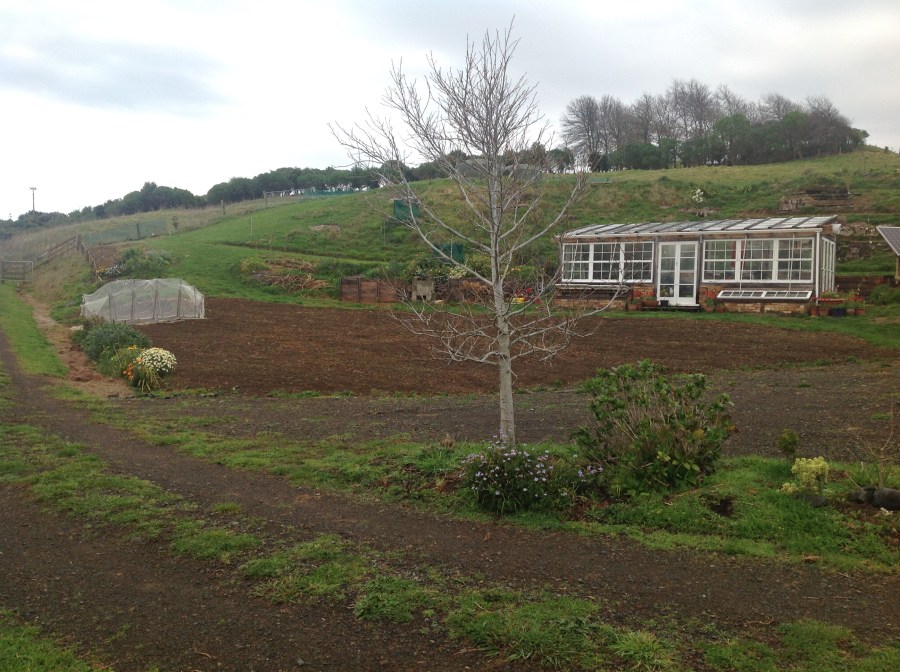
The photo is from September, showing where the peas are.

We were away last weekend. Back in the city I made about 100 small paper pots and planted them with Florida F1 Sweetcorn. It’s been cold and hailing last week, but many of them have come up as I was able to give them turns on the heat pad. They are up to 2 inches high now, not even a week later. My plan is to plant them in the garden below the greenhouse.

I plan to do this for the flour and polenta corn as well, since over the past years I have sometimes had to replant entire crops. The earth is wet here at this time of year, and in some of the beds there are still clumps of clay. I will make more paper pots tonight.

This year we have peas next to the Louisa plum.  The soil was nice and friable and I spread lime around them. Carouby mange tout with their purple flowers were the strongest growers again, they have tiny peas and  lots of lovely purple flowers on them now.  The sweeter sugar snaps have been slow and needed 2 sowings, nd the normal peas even worse with about 8 plants coming up out of a whole packet.
Parsnips and carrots are up in the same area.

Tomatoes are in front of the greenhouse and in the top garden right side this year.
I will have to draw out some garden sections so I can refer to them by name. The garden below has been dug but needs hoeing.

I also transplanted another batch of tomatoes into 3″ square pots last weekend. These are the Orange high lycopene ones for eating raw. This year I have tried Golden Grape, Gold Medal, Moonglow, and Elbe from Bristol seeds in Whanganui. We will see what grows well and what tastes good. I have put one of each in the greenhouse an the rest will go in up top next week. I think they are better grown into at least 5″ pots in shelter.

The Beefsteak, Albenga Ox, and Brandywine tomatoes went in 50 x 2 weeks ago, the rest 3 weeks ago. The weather has been insanely windy and quite cold as it was last year at this time.

We used a different type of staking system, which we tried last year for one row. This is a long row of Macrocarpa stake triads connected by wire. This is what I used for the peas this year, covered with netting to protect from birds, which I removed yesterday as the peas were tangling into it.

We also used stakes to fence the tomatoes with wind cloth, thank goodness. More strong gales and rain today and it’s cold enough that we needed the heater last night and it would be nice now as well.

The tomatoes that went outside were a good size, all in 5 or 8 inch pots. We have lost one so far, one of the early batch before we had the complete wind cloth fence up. The bigger ones have been strung up with green jute twine. The others need to go up soon they are starting to grow lying down.

In with the toms I planted a few zephyr and Italian courgettes and some cucumbers. They are all a little miserable, and I’ve lost one of each, but they are alive and one is trying to make a tiny zephyr zucchini.

In the greenhouse I dug all the beds and planted 3 toms, Brandywine mix and Beefsteak in them. They have developed small tomatoes in the last 2 weeks. They were very dry yesterday after 2 weeks without water. I also put in a few of each pepper type – Ancho, Little Hat, Bell Colours, and Topepo and some sugar baby watermelons, tomatillos, and eggplant. They are all doing fine. I have planted some banana melons but they haven’t come up yet.

New Fruit Trees, and Dahlias

It’s been a very windy week here, and rainy in the city. Down here there has been almost no rain, and the wind has dried things up a bit. We got some bare root trees, which got lost on the courier so have been travelling for over a week, so they really need to go in the ground.
Today of course it is raining. We have been out in rain jackets and picked spots and dug 3 holes, which I have covered with coffee bags to keep the rain out. I need to carry more compost and good dirt up the hill, and dig 3 more holes. But we have come in, it’s raining too hard. I didn’t get wet thanks to my rain gear, but my gloves were wet through. These are the ones that have to go in asap:

1 apricot Fitzroy on peach rootstock
1 apple Freyburg on MM 106
1 apple Reinette du Canada
1 apple Granny Smith on Northern Spy
1 pear William Bon Cretien on Quince
1 pear Doyenne du Commice on Quince

I also got a grape, Niagra, and 11 Chilean guavas, a Persimmon, and a mini kiwifruit – a girl and a boy. I have just left these in the rain for today. The Chilean guavas look in good condition.
Lots of the other plants I put in last week got a bit battered by the wind and dryness. The lavenders which I brutally transplanted look OK so far which is a surprise.

12 Dahlias came, Ron Howard and a few others I ordered must be out of stock.
3x Nuit d’Etre
3x Amorangi Pearl
3x Cameo
3x Mary Evelyn
It says to plant these in flats in some nice potting mix – so I could take them out to the greenhouse. I need to get some compost and bring it into the greenhouse first though.

Sunrise 2 weeks After the shortest day

The sun has already started moving back. Today it was almost directly over the little valley- even slightly to the east of it. It’s amazing how quickly it changes. This month is the celebration of Matariki, when Matariki, the 7 sisters, or Subaru is supposed to be visible around sunrise. It was too bright to see by the time I went out.

When we build the house, I would like to be able to see the sunrise from bed, in winter.
In the kitchen the tea making counter should look to the little valley as well.

Miners lettuce Claytonia perfoliata

First Feed of Miner’s Lettuce this year

I love this winter salad green which seems to pop up in Winter the way it’s relative Common Purslane pops up in Summer, except that for us the summer version is much more ubiquitous (often called a weed, but also very nice in salads).

Miner’ lettuce pretty much stays where you put it, and can even die out if it gets too dry or overrun by weeds. If it’s growing well it’s thick – to harvest it you can just cut it off with scissors far enough above the ground to avoid any dirt. Claytonia perfoliata is its proper name.

Although it’s native to Canada where I grew up, I had never noticed it as a plant or a vegetable until I came to New Zealand. I imagined that the name ‘Miner’s Lettuce’ came from the shape of the leaves which are like a tiny shovel, but according to Wikipedia the leaves were a source of vitamin C for the California Gold Miners hence the name.

Also on the plate is another yummy veg, what we call ‘smashed parrot’, parsnips and carrots boiled together and mashed lightly with butter.